Table of Contents
S3 Compatible Storage On-Prem
In the world of enterprise storage, a new hero is rising and it’s called S3 compatible storage. What started as a cloud-only wonder is now sneaking into on-premise data centers and private clouds, ready to shake things up.
The magic behind 'S3 compatible' is simple - it means the storage speaks the S3 API language fluently. If your application understands S3, it’ll work seamlessly with S3 compatible storage, like a perfect dance partner.
More and more applications are jumping on this bandwagon because S3 compatible storage has some serious perks. Here's why Rabata and others are betting on it:
- Scale: It’s built to grow without limits, all under one roof - one namespace to rule them all.
- Geo-distribution: Imagine one storage system that can stretch across multiple locations, keeping your data connected no matter where it lives.
- Cost: Designed to run on standard servers, it lets you snag the best deals and efficiency the hardware market can offer.
- Reliable data transport: Created in the internet age, S3-compatible storage excels at moving huge data mountains across wide networks without breaking a sweat.
Cloudian leads the pack in S3-compatible storage, but plenty of familiar names like Rubrik, Veeam, Commvault, Splunk, and NetApp have also embraced it. Adobe, VERITAS, Hadoop, EMC, Komprise - this list reads like the who’s who of storage and data management.
And this is just the tip of the iceberg in our deep dive into the world of S3 storage.
Clearing Up the Jargon
Now, let's demystify S3-compatible storage a bit more. This storage style carries quite a few nicknames, so keep up.
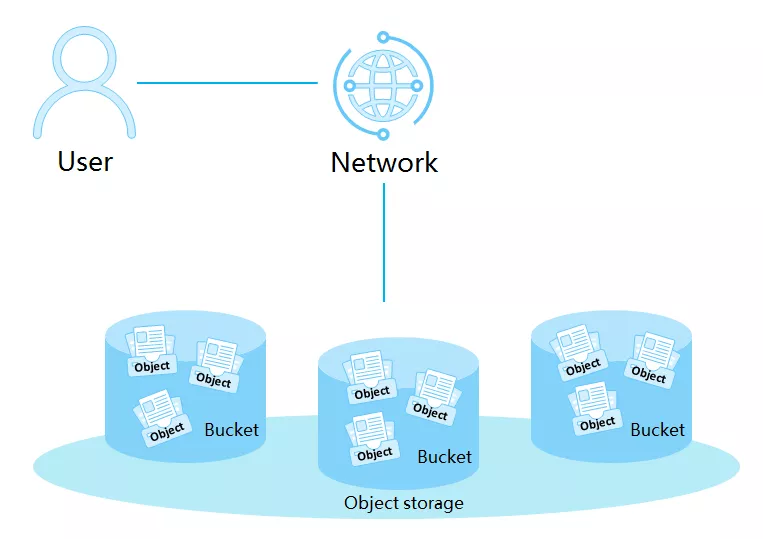
It’s often called object storage because the technology underneath organizes data as - surprise - objects. Over time, developers used various APIs to interact with object storage, but S3 API has now taken the crown as the most popular.
Sometimes you’ll hear 'cloud storage' thrown around. Most cloud storage today is actually object storage using the S3 API. So these different terms? They’re mostly describing the same great thing: S3-compatible storage.
Why Choose S3 Compatible Storage On-Prem?
Deploying S3 compatible storage right in your own data center comes with some seriously compelling perks. Imagine expanding your storage effortlessly to an exabyte scale without breaking a sweat or interrupting your workflow. That’s exactly what S3-compatible solutions bring to the table - a single namespace that grows with your needs, no fuss involved.
Think of the cost savings like finding a hidden treasure. On-prem S3 storage often costs up to 70% less than public cloud options. This isn’t magic - it’s thanks to using industry-standard hardware that packs more data into less space and slashes your per-GB expenses. Plus, there’s no sneaky ingress or egress fees draining your budget.
When speed matters, keeping your storage close by matters even more. Hosting your hardware inside your data center means you get lightning-fast response times and plenty of bandwidth. No more waiting around as your data zips back and forth across the internet.
Security-conscious folks will appreciate the peace of mind that comes with having full control. Your data stays safely behind your firewall, letting you enforce security policies and manage access exactly how you want. No surprises, no backdoors.
Flexibility is another big win here. Since S3 is the common language between on-prem storage and public clouds, you’re never locked in. You can start using cloud resources seamlessly when needed and tap into the ever-growing ecosystem of S3-compatible apps without missing a beat. Moving data and apps between your servers and the cloud becomes a smooth, hassle-free dance.
- Scale effortlessly to an exabyte in a single namespace without downtime
- Save up to 70% compared to public cloud storage costs with standard hardware and zero ingress/egress fees
- Enjoy low latency and high bandwidth with local hardware
- Maintain strict control over data behind your own firewall
- Seamlessly integrate with cloud environments and S3-compatible apps
Comparison Table
| Provider | Price | Free Tier | Durability | Uptime SLA | Versioning | Notes |
| Backblaze B2 | $0.006 / GB / month | Free up to 3× storage, then $0.01 / GB | 99.999999999% (11 nines) | 99.9% | No | Widely adopted, solid reliability, easy S3 API |
| Wasabi | $0.00699 / GB / month | Free | 99.999999999% (11 nines) | 99.9% | No | Requires 90-day minimum retention, fully S3-compatible |
| Cloudflare R2 | $0.015 / GB / month | Free | Not explicitly stated | Not stated | 10 GB storage + 1M writes + 10M reads/month | Pays for read/write ops, strong edge caching network |
| Hetzner Object Storage | $0.00713 / GB / month | $0.00143 / GB | Not stated | Not stated | No | Great price/performance, limited data centers, restrictive account policy |
| MinIO | Depends on infra | Depends on infra | Depends on setup | Depends on setup | No | Self-hosted, open-source, requires setup and maintenance, durability is debatable |
Hetzner Object Storage
Hetzner offers a strong European contender for object storage, boasting impressive price-to-performance that catches the eye immediately. While the service is relatively new on the scene - and early beta tests revealed some hiccups - their reputation suggests these kinks have been ironed out. It's a smart choice for those seeking solid storage without breaking the bank.
Storage costs at Hetzner sit comfortably at $0.00713 per gigabyte each month, which makes it a wallet-friendly option compared to many others. What really turns heads is their egress pricing: just $0.00143 per gigabyte. To put that in perspective, this is roughly 60 times cheaper than AWS egress fees. If you’re moving data in and out frequently, that saving adds up fast.
Of course, there are a couple of trade-offs. Hetzner’s data centers don’t span the globe like some competitors, so if you need truly global presence, this might be a sticking point. Also, their sign-up process is a bit like applying for a secret club membership - strict and cautious, designed to keep scammers and troublemakers at bay. So, patience and some paperwork might be part of your onboarding adventure.
Benefits
Scalability
Rabata’s cloud storage handles data like a pro, scaling effortlessly from a few gigabytes to mind-boggling exabytes without breaking a sweat. You add data, it grows; you delete data, it shrinks. No complex setup or storage guessing games. Just pure elastic storage that bills you only for what you actually use.
Durability and availability
Imagine a vault so secure it’s almost impossible to lose your data. That’s what Rabata’s cloud storage delivers. Built on a unique, battle-tested architecture, it guarantees data durability measured in 11 nines - yes, that’s 99.999999999%. And if you expect downtime, think again. With 99.99% availability, your data is ready when you are, backed by some of the toughest cloud service agreements out there.
Security and data protection
Rabata takes data security seriously, like a bodyguard who never sleeps. Your files are always private, encrypted by default, and guarded with strict access controls. Plus, it offers detailed auditing tools so you can keep an eye on who’s poking around your storage. Compliance and protection? Covered.
Lowest price and highest performance
Why pay more for less? Rabata combines affordability with speed and resilience. Multiple storage tiers let you choose whether your data needs to be lightning fast or more budget-friendly. Automated lifecycle management moves data seamlessly between these tiers - no hassle, no extra cost. This means you get the best performance without your wallet taking a hit.
Top S3-Compatible Storage Management Solutions
Tackling the headache of managing S3-compatible storage means juggling cost, speed, and security all at once. Luckily, a handful of savvy platforms step up to the challenge, each bringing their own unique strengths to the table. Let’s take a closer look at the heavy hitters making waves in the storage world.
Cloudian
Cloudian is like the Swiss Army knife for data-heavy workloads involving AI, big data, and analytics. Its software-defined object storage seamlessly speaks the S3 API language, opening doors to a broad ecosystem of applications. Whether it's powering AI frameworks like TensorFlow or crunching numbers with Apache Spark, Cloudian consolidates your data into one secure, scalable, and budget-friendly fortress.
It’s built for speed and scale, handling exabytes of data and pushing throughput into terabytes per second. For enterprises, it offers tight multi-tenancy controls, ensuring different teams or projects don’t step on each other’s toes. Plus, with cost-saving features like tiered storage that can slide data between your own infrastructure and public clouds, Cloudian helps keep your expenses lean.
Durability isn’t an afterthought either. Its built-in replication and erasure coding mean your data stays safe and available, come rain or ransomware. Speaking of which, Cloudian adds an extra security layer with immutable storage that locks down your data from tampering. It’s like a digital Fort Knox for sensitive information.
- Native S3 API support for smooth integration with existing tools
- Scale to exabytes with blazing throughput tailored for AI and big data
- Fine-grained access controls to meet stiff enterprise security demands
- Cost-efficient operation on standard hardware with cloud tiering options
- Robust data protection with replication and erasure coding
- Ransomware-proof, immutable storage backed by multi-layered defenses
Ceph
Ceph is the multitool of open source storage, blending object, block, and file storage into a single, elegant system. It’s designed to crush the old problems of fragmented storage infrastructures by uniting everything under one roof. Whether you’re running stuff on-premises, juggling cloud resources, or spinning up containers, Ceph flexes to fit your needs.
Scaling with Ceph is more like adding pieces to a puzzle without stopping the game. Thanks to its CRUSH algorithm, data spreads evenly across servers, avoiding bottlenecks and downtime. If something slips, Ceph’s self-healing daemons jump in to fix issues on the fly, sparing admins headaches.
The icing on the cake? Ceph runs happily on off-the-shelf hardware. No vendor gatekeeping here - it cuts costs and adds freedom, letting you choose hardware that fits both your budget and performance needs. Plus, you get to tune performance to your exact workload without being boxed in by proprietary system limits.
- Single cluster for object (S3), block, and file storage keeps things simple
- Non-disruptive scaling powered by smart data distribution
- Automatic detection and repair of faults with minimal manual effort
- Works on commodity hardware, avoiding vendor lock-in
- Customizable performance tailored to your workload’s quirks
NetApp StorageGRID
NetApp StorageGRID puts simplicity front and center for managing storage across on-premises and hybrid clouds. Whether your data lives at headquarters or spreads out over multiple cloud services, StorageGRID acts as a command hub, making everything easier to control under one roof.
It’s not just a storage box - StorageGRID is packed with protective mechanisms like backups, replication, and ransomware defenses. The hybrid cloud magic happens through smooth integration with major players like AWS, Azure, and Google Cloud, giving you flexible options for tiering and backups.
And when it comes to squeezing the most out of your storage space, technologies like deduplication and compression mean less wasted space and lower costs. Centralized management tools provide a dashboard that brings complex, multi-site environments into clear focus.
- Comprehensive data protection with backup, replication, and ransomware resistance
- Seamless hybrid cloud integration with AWS, Azure, and Google Cloud
- Space-saving deduplication, compression, and compaction technologies
- Unified control panel for storage management across all locations
Dell ECS
Dell Elastic Cloud Storage (ECS) serves enterprises hungry for scalable, S3-compatible storage that plays well across multi-cloud setups. Whether you’re diving into analytics, AI, IoT projects, or just backing up mountains of data, ECS is engineered for flexible deployments - from your data center to the cloud, or even as a managed service.
Its global namespace feature acts like a universal translator, offering a federated, unified view across all your geographically scattered storage. This helps you avoid the mess of juggling multiple silos. On the performance front, ECS handles hefty workloads by scaling horizontally without breaking a sweat.
Security and compliance get top billing here - with encryption, strict access controls, and WORM (write once read many) support ensuring your data meets even the stickiest regulations. ECS also keeps tenants neatly contained in multi-tenant environments, preventing data overcrowding.
- S3 API compatible for smooth migration of cloud-native apps
- Global namespace for unified management across distributed deployments
- Horizontally scalable for massive workloads
- Robust security with encryption, access policies, and WORM compliance
- Multi-tenant support offering isolated environments within shared infrastructure
Scality
Scality has carved out its niche by mastering unstructured data management in enterprises and service providers. Its Ring architecture acts like a data spider web, delivering high availability and near-limitless petabyte-to-exabyte scaling. Those managing video surveillance, backups, big data analytics, and archival workloads will find a trusted ally here.
This platform’s native S3 interface means your existing cloud apps and tools continue to work without a hiccup. As your data grows, Scality’s scale-out architecture keeps performance and capacity increasing linearly - no sudden surprises, just smooth, predictable expansion.
Thanks to geo-redundancy powered by erasure coding and replication, your data is spread cleverly across locations to boost durability. Policy-based tiering automates moving colder data off to public clouds or cheaper storage, while a built-in observability toolkit feeds you metrics, logs, and alerts to keep an eye on everything.
- Fully native S3 interface for seamless compatibility
- Ring-based scale-out architecture supporting petabyte to exabyte growth
- Geo-redundant data distribution with erasure coding and replication
- Automated tiering for lifecycle and cold data management
- Integrated monitoring and analytics for proactive oversight

Comments